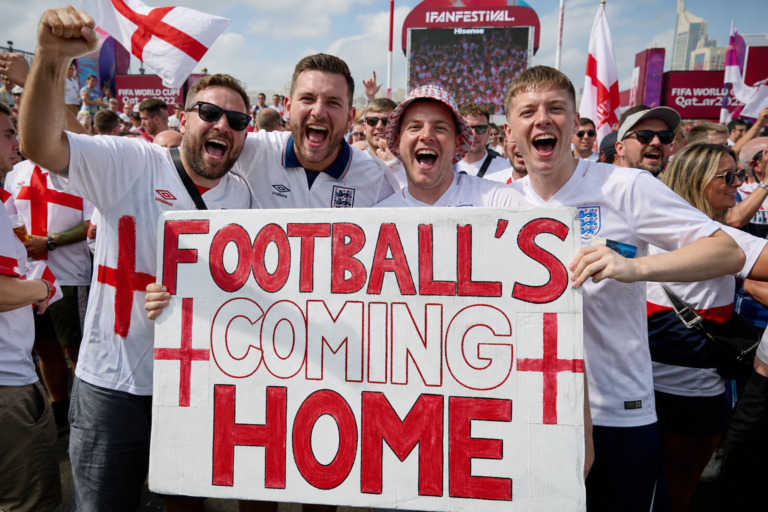

The phrase “Football’s Coming Home” has become one of the most recognisable expressions in British sporting culture. It appears every time England enters a major tournament, bringing with it a mixture of optimism, nostalgia, humour, and decades of shared disappointment. For many England supporters, the phrase is not a genuine prediction that victory is guaranteed. Instead, it represents the unique emotional experience of following a national team that continues to inspire hope despite many years without winning the FIFA World Cup.
More than three decades after the song that introduced the phrase was released, “Football’s Coming Home” remains part of the national conversation during major tournaments. It reflects England’s football history, its relationship with success and failure, and the particular way British fans often combine confidence with self-deprecating humour.
Where Did “Football’s Coming Home” Come From?
The phrase originates from the 1996 song “Three Lions”, created for the UEFA European Championship held in England. The song was written by comedians David Baddiel and Frank Skinner alongside the band The Lightning Seeds.
The central line, “It’s coming home”, referred to football returning to England as the host nation of the tournament. England is widely considered the birthplace of modern association football, with the Football Association, founded in 1863, creating the first standardised rules of the game.
However, the phrase quickly gained a deeper meaning. It became linked not only with England hosting a tournament but also with the dream of winning another major trophy after the nation’s 1966 World Cup victory.
Why 1966 Still Defines England’s World Cup Identity
England’s victory in the 1966 FIFA World Cup remains one of the most important moments in British sporting history. The team, led by captain Bobby Moore, defeated West Germany 4–2 after extra time in the final at Wembley Stadium.
That triumph created a national memory that has shaped expectations ever since. Every generation of England supporters has grown up hearing stories of the 1966 team and wondering whether they will witness another moment like it.
The long gap between major trophies has made the hope of future success even more significant. For some fans, the belief that “football is coming home” represents the possibility of ending nearly six decades of waiting.
Hope, Heartbreak and the England Supporter Experience
England’s history in international tournaments has been defined by a cycle of optimism followed by disappointment. Supporters have experienced dramatic victories, controversial moments, and some of football’s most painful defeats.
Many of the most memorable moments involve penalty shoot-outs. England suffered famous losses in the 1990 World Cup semi-final, Euro 1996 semi-final, the 1998 World Cup, and several later tournaments.
These experiences helped create a particular style of support where fans can be passionate and hopeful while also expecting something to go wrong. The phrase “Football’s Coming Home” captures this contradiction perfectly.
It is often sung with genuine belief, but also with an awareness of England’s history. The humour and irony behind the phrase are part of what makes it distinctly British.
Why Other Countries Sometimes Misunderstand the Phrase
Outside the United Kingdom, “Football’s Coming Home” is sometimes interpreted as arrogance or an assumption that England should win every tournament. This interpretation often misses the cultural context behind the expression.
The original song is filled with references to years of disappointment and missed opportunities. Its message is not simply that England expects victory. Instead, it describes the irrational optimism of supporters who continue to dream despite repeated setbacks.
This combination of confidence and self-awareness is common in British humour. Fans can sing about bringing football home while also making jokes about the possibility of another painful exit from the tournament.
How the Phrase Became a Modern British Tradition
Every major tournament brings a familiar scene across Britain. Pubs fill with supporters wearing England shirts, families gather around televisions, and social media becomes filled with predictions, jokes, and celebrations.
The phrase “Football’s Coming Home” appears on banners, in conversations, and in newspaper headlines. It has become part of the ritual of supporting England rather than simply a song lyric.
The tradition also crosses generations. Older supporters remember the heartbreak of earlier tournaments, while younger fans associate the phrase with more recent campaigns and the atmosphere of watching England compete with friends and family.
Has England’s Recent Success Changed the Meaning?
For many years, the phrase was associated almost entirely with nostalgia and unlikely hope. However, England’s performances in recent tournaments have changed the conversation.
The team reached the semi-finals of the 2018 FIFA World Cup and the final of the UEFA European Championship in 2021 and 2024. These performances created a stronger belief that England can genuinely compete for major trophies.
As a result, “Football’s Coming Home” now carries a slightly different feeling. It still contains humour and caution, but it is also supported by a generation of players who have repeatedly reached the later stages of international competitions.
Why Does “Football’s Coming Home” Matter Beyond Sport?
Major football tournaments often become national moments that go beyond the matches themselves. They influence conversations at work, gatherings in pubs, family events, and shared experiences between strangers.
For England supporters, “Football’s Coming Home” represents belonging as much as ambition. It is a phrase that allows millions of people to share excitement, frustration, memories, and hope during a few weeks of international competition.
Its continued popularity demonstrates how sport can create traditions that become part of a country’s wider cultural identity.
What does “Football’s Coming Home” actually mean?
The phrase originally referred to football returning to England as the host of Euro 1996. Today it generally represents England supporters’ hope of winning a major international tournament, combined with an awareness of past disappointments.
Why do England fans sing “Football’s Coming Home”?
Fans sing it because it has become a tradition linked to supporting England at major tournaments. It expresses excitement, nostalgia, humour, and the emotional highs and lows of following the national team.
Do England fans genuinely believe they will win every tournament?
No. Although some supporters are confident, the phrase is often used with irony and self-awareness. The song itself acknowledges England’s long history of tournament disappointment.
When was the last time England won the World Cup?
England won the FIFA World Cup in 1966 after defeating West Germany in the final at Wembley Stadium. It remains the men’s national team’s only World Cup victory.
Why is the phrase sometimes criticised outside Britain?
Some international supporters interpret it as a statement of superiority or entitlement. However, many British fans see it as a humorous expression of hope that reflects decades of both optimism and disappointment.
More than a football chant, “Football’s Coming Home” has become a cultural tradition that tells a story about England’s relationship with the game. It combines history, humour, national identity, and the enduring belief that the next tournament might finally be the one that creates a new generation of memories.